
Driving Licence Explained!
If you’ve just passed your test (especially if you’ve had your lessons with Amdi Driving School 😊) or exchanged a foreign licence for a GB licence, the codes and categories on your photocard can look confusing.
Below, we explain the front and back of a full UK photocard driving licence, plus the main vehicle categories and country codes.
The old green paper counterpart is no longer issued by the DVLA.
All penalty points and status info are now stored digitally, and the paper counterpart no longer has any legal status.
Although the images shown represent a genuine-style UK driving licence, the details are fictional and do not match any real DVLA record.
Ask your AMDI instructor during lessons and we’ll explain your categories in simple terms.
Manual driving lessons →
Automatic driving lessons →
Front of the Photocard Driving Licence Explained
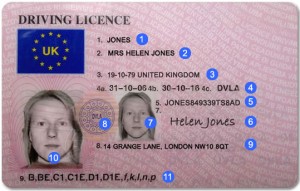
Front of the UK photocard driving licence explained
- Your personal details (1, 2 and 3): Fields 1, 2 and 3 show your surname, first names, and your date and place of birth.
- Issue date, expiry date and issuing authority (4): 4a – Date the photocard was issued.
4b – Date the photocard expires (you must renew by this date).
4c – The authority that issued the licence (DVLA). - Driver number (5): This is your unique driving licence number. The format contains:
- JONES – First five letters of your surname. If your surname is shorter, spare spaces are filled with the digit 9.
- 849339 – The first and last numbers are your year of birth. The 2nd and 3rd numbers are the month of birth. For female drivers, 5 is added to the second digit (so it will be 5 or 6). The 4th and 5th digits show the day of the month you were born.
- TS – First initials of your forenames. If you only have one forename, the second character becomes 9.
- 8AD – Computer check digits used by the DVLA.
- ** – Licence issue numbers (used if a licence is replaced/updated).
- Licence holder’s signature (6): Digitally reproduced from your application and securely printed into the card.
- Ghost photograph (7): A smaller, faint version of your photo used as a security feature.
- Issuing authority roundel (8): Shows the stamp of the EC authority that issued the licence.
- Holder’s address (9): Your permanent address in Great Britain. You must update this if you move.
- Holder’s photograph (10): Your main photo as supplied on your application.
- Entitlement categories (11): The capital letters show the vehicle categories you’re allowed to drive under EU rules. Any extra national categories are shown in smaller letters.
Back of the Photocard Driving Licence Explained
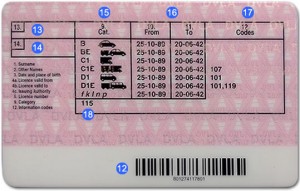
Rear of UK driving licence explained
- Production barcode (12): Used during production to link your photocard with any paperwork when it is dispatched.
- Not used (13 / 14): Currently unused spaces on the card.
- Pictograms (15): Small pictures showing vehicle types. These match the categories in the table below so you can easily see what you’re allowed to drive.
Provisional Driving Licence
A GB provisional licence shows the same type of information as a full licence.
Since September 1999, the DVLA has added a red “L” symbol on provisional licences to show the holder is a learner driver.
How Long Does It Take for My Driving Licence to Arrive?
You will usually receive your driving licence within three weeks.
If you passed your practical test and handed your provisional licence to the examiner, the test pass certificate they give you allows you to drive legally until your full licence arrives.
How Long Does a Driving Licence Last?
Your photocard driving licence must be renewed every 10 years.
On the front of the card:
- 4a – Date the card was issued
- 4b – Date the card expires (renew by this date)
If the DVLA has your correct address, they’ll usually send you a renewal form about two months before your licence runs out.
Which Countries Can I Drive In with a UK Licence?
A full and valid GB driving licence allows you to drive in all European Union (EU) and European Economic Area (EEA) countries, plus Switzerland.
Outside the EU/EEA, you may need an International Driving Permit depending on the country’s rules.
Current EU/EEA countries include:
Austria, Belgium, Bulgaria, Czech Republic, Republic of Cyprus, Denmark, Estonia, Finland, France, Germany, Greece, Hungary, Iceland, Ireland, Italy, Latvia, Liechtenstein, Lithuania, Luxembourg, Malta, Netherlands, Norway, Poland, Portugal, Romania, Slovenia, Slovakia, Spain and Sweden.
Driving Licence Country Codes
If you exchange a foreign licence for a GB licence, a country code is shown to indicate where your original licence was issued.
| Australia | AUS | Gibraltar | GBZ | Monaco | MC |
| Austria | A | Greece | GR | Netherlands | Nl |
| Barbados | BDS | Guernsey | GBG | New Zealand | NZ |
| Belgium | B | Hong Kong | HK | Norway | N |
| British Virgin Islands | VGB | Hungary | H | Poland | PL |
| Bulgaria | BG | Iceland | IS | Portugal | P |
| Canada | CDN | Ireland | IRL | Republic of Korea | ROK |
| Cyprus | CY | Isle of Man | GBM | Romania | RO |
| Czech Republic | CZ | Italy | I | Singapore | SGP |
| Denmark | DK | Japan | J | Slovakia | SK |
| Estonia | EST | Jersey | GBJ | Slovenia | SLO |
| Falkland Islands | FK | Latvia | LV | South Africa | ZA |
| Faroe Islands | FO | Liechtenstein | FL | Spain | E |
| Finland | FIN | Lithuania | LT | Sweden | S |
| France | F | Luxembourg | L | Switzerland | CH |
| Germany | D | Malta | M | Zimbabwe | ZW |
Driving Licence Vehicle Categories
These are the main vehicle categories shown on your UK driving licence:
| A1 | Light motorcycles up to 125cc and a power output of no more than 11kW (14.6bhp). |
| A | Motorcycles, with or without a sidecar. |
| B1 | Motor tricycles or quad bikes weighing up to 550kg (without passengers). |
| B | Motor cars or light vans with up to eight passenger seats, up to 3500kg. A light trailer can be attached. |
| C1 | Vehicles between 3500kg and 7500kg. A trailer up to 750kg can be attached. |
| C | Vehicles over 3500kg. A trailer up to 750kg can be attached. |
| D1 | Small passenger vehicles with 9–16 passenger seats. A trailer up to 750kg can be attached. |
| D | Any bus with more than eight passenger seats. A trailer up to 750kg can be attached. |
| B+E | Cars or light vans (up to 3500kg, up to eight passenger seats) pulling a heavier trailer. |
| C1+E | Vehicles between 3500kg and 7500kg pulling a trailer over 750kg (combined weight max 12000kg). |
| C+E | Vehicles over 3500kg pulling a trailer over 750kg. |
| D1+E | Small passenger vehicles (9–16 seats) with a trailer over 750kg (combined weight max 12000kg). |
| D+E | Any bus with more than eight passenger seats pulling a trailer over 750kg. |
| f | Agricultural tractors. |
| g | Road rollers. |
| h | Tracked vehicles. |
| k | Pedestrian-controlled vehicles. |
| l | Electric vehicles. |
| n | Vehicles used for very short distances on public roads. |
| p | Mopeds. |
Turn licence knowledge into safe driving
Understanding your licence is a great start — practising with an instructor builds real confidence on the road.
- Choose manual or automatic lessons
- Check lesson prices and plan your first session
- Contact us to book your lessons
Manual lesson prices →
Automatic lesson prices →
Contact us →
DVSA-Approved Instructor • Manual & Automatic • ★★★★★ Local Reviews
Start here: AMDI Driving School