
Learning How to Deal With Double Roundabouts
A single roundabout can be challenging enough when you’re learning. A double roundabout is, of course, double the challenge.
Double roundabouts can be:
- two full-sized roundabouts joined together, or
- two mini roundabouts close to each other.
The same basic rules apply to both types, but your approach and planning need to be very clear. If double roundabouts exist on your local test routes, there’s a good chance they’ll appear on your driving test.
The key is simple: treat each roundabout separately and use the MSPSL routine every time:
Mirror – Signal – Position – Speed – Look.
Practise them step-by-step with a DVSA-approved instructor in Hackney and East London.
View manual lesson prices →
View automatic lesson prices →
Or call us on 07866 941 436
The diagram below shows a large double roundabout with exits leading onto dual carriageways. We’ll follow the red car taking the correct route to turn right through both roundabouts using the MSPSL routine.
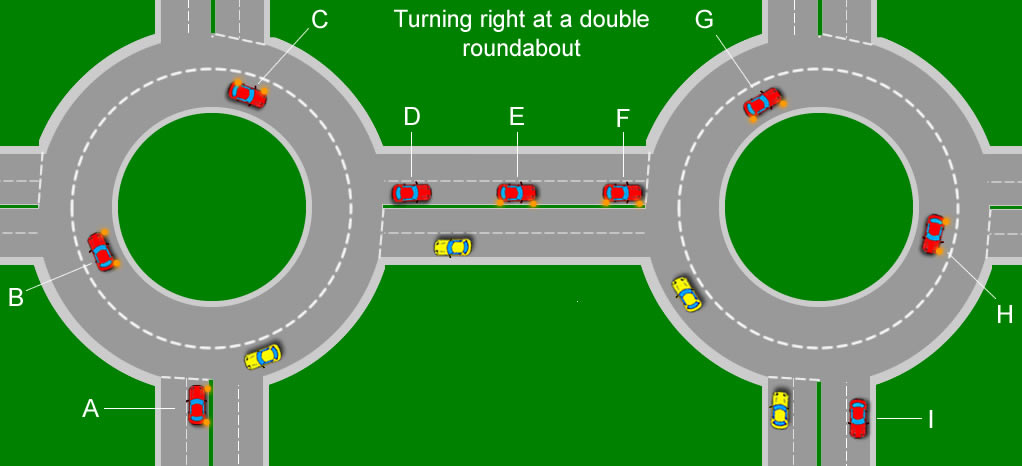
Turning right at a large double roundabout, typically from a dual carriageway
How to Use a Large Double Roundabout
We’ll assume you are:
- approaching on a dual carriageway, and
- turning right at both roundabouts (third exit each time).
- A – Approach
As you approach the first roundabout, check your interior mirror, then your right mirror, and signal right.
Move into the right-hand lane. If you are changing from the left lane, check your right blind spot before signalling and before moving across. - B – Join the First Roundabout
At the give-way line, look to the right. When it is safe, join the roundabout using the inside (right) lane. - C – Prepare to Exit the First Roundabout
Just after passing the second exit, check your interior mirror and left mirror, then check your left blind spot and signal left.
Cross safely into the left lane to leave at the third exit. - D – Between the Two Roundabouts
After leaving the first roundabout, stay in the right-hand lane if you will be turning right again at the second roundabout. This sets you up correctly for the next approach. - E – Approach the Second Roundabout
Once again, check the interior mirror and right mirror and signal right as you approach the second roundabout. - F – Give Way
At the second give-way line, give way to traffic from the right. - G – Join the Second Roundabout
When clear, enter using the inside (right) lane again. - H – Exit the Second Roundabout
Just after the second exit, check your interior mirror, left mirror and left blind spot, then signal left and move safely into the left lane to leave at the third exit. - I – After the Exit
Once you have taken the exit, make sure your indicator has cancelled so it doesn’t confuse other drivers.
Multi-Lane Double Roundabouts
Some very large double roundabouts have more than two lanes. In these cases, always:
- read the road signs early, and
- follow the lane arrows and markings on the road.
If you realise you are in the wrong lane, it is better to stay safe and follow the lane, then re-route, than to force a dangerous lane change.
We’ll take you through them from every direction so there are no surprises on your test.
Contact us to check availability →
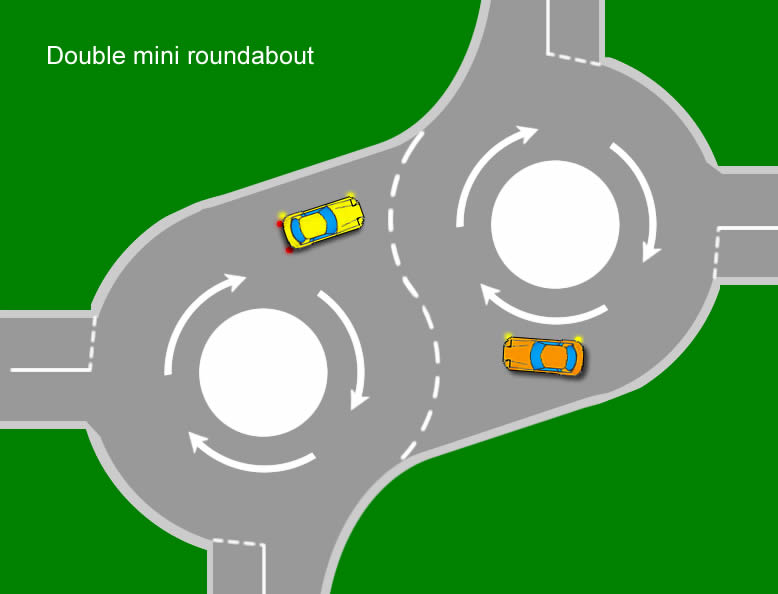
Mini double roundabout layout with signs and markings
Double Mini Roundabouts
Double mini roundabouts are usually found on busy residential roads where space is tight but traffic flow needs controlling.
They can look confusing at first, but the rule is simple:
- treat each mini roundabout as a separate junction.
Approach slowly and:
- watch other vehicles’ indicators,
- look at the angle of their car to guess where they are going, and
- always be ready to give way to the right.
In the example shown, the yellow car wants to turn left at the second mini roundabout but must give way to the orange car approaching from the right and turning right.
Because the two roundabouts are close together:
- keep your speed very low,
- cover the brake, and
- only commit to moving when you are sure it is safe.
Double Mini Roundabouts and Cyclists
Cyclists can be unpredictable and may not always signal their intentions with arm signals.
When dealing with double mini roundabouts:
- approach slowly so you have time to see what cyclists are doing,
- do not try to squeeze past them on or near the roundabout, and
- wait until they have cleared the junction before overtaking.
Patience here is much safer – and it will look better on your driving test.
Related Roundabout Guides and Tutorials
We’ll practise single, double and mini roundabouts on real test routes around Hackney and East London.
View manual lesson prices →
View automatic lesson prices →
Contact us to book lessons →
DVSA-Approved Instructor • Manual & Automatic • ★★★★★ Local Reviews
Start here: AMDI Driving School
