
Learning How to Deal With Roundabouts
If you are new to the UK or new to driving, roundabouts can feel confusing and stressful. There is a lot happening at once and sometimes quick decisions are needed.
There is a good chance that roundabouts are on the driving test routes for your local test centre. Examiners often include the most challenging roundabouts in the area – from small mini roundabouts to large multi-lane systems.
These tutorials help both learner and experienced drivers understand:
- how roundabouts work,
- what examiners expect on test, and
- how to stay safe and calm.
Practise them calmly with a DVSA-approved instructor who knows the local test routes.
View manual lesson prices →
View automatic lesson prices →
How Roundabouts Work
There are two main types of roundabouts:
- Standard roundabouts – shown by a red triangle warning sign. These can be single-lane or multi-lane and are usually found on busier roads.
- Mini roundabouts – shown by a blue circle with white arrows. These are often found in residential areas and tight junctions.
For more detail on smaller junctions, see:
Approaching traffic must always give way to traffic already on the roundabout. In the UK, that means you must give way to traffic approaching from the right.
A learner driver is likely to encounter:
- larger multi-lane roundabouts, and
- mini roundabouts in residential areas
during the driving test (if they exist on local routes).
Roundabouts Are Just Junctions
Roundabouts are simply a type of junction and should be approached in a similar way.
While driving, look out for:
- road signs warning of a roundabout ahead, and
- traffic crossing in front of you – often a clue that a junction or roundabout is coming up.
Spotting a roundabout early gives you more time to:
- check mirrors,
- choose the correct lane, and
- adjust your speed smoothly.
Open and Closed Roundabouts
Roundabouts can be:
- Open – you can clearly see traffic approaching from the right as you approach. Often bigger, on main roads. You may not need to stop if all is clear.
- Closed – your view is blocked by trees, walls, fences or buildings. Usually smaller and in residential areas. You will often need to slow right down or stop at the line.
Your approach speed must match what you can see:
- The less you can see, the slower you go.
MSPSL – The Core Roundabout Routine
Whenever you have located a roundabout ahead, the examiner will expect you to use the MSPSL routine:
- Mirror
- Signal
- Position
- Speed
- Look
This should be applied every time you approach a roundabout – turning left, going straight ahead or turning right.
Roundabout Rules – What the Examiner Expects
Below is the basic procedure the examiner will look for when:
- turning left,
- following the road ahead, and
- turning right at a roundabout.
Turning Left at a Roundabout
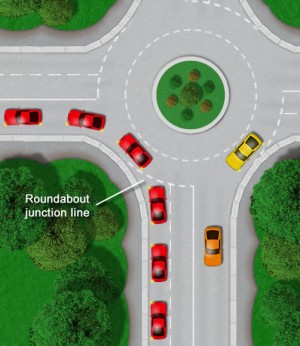
Turning left at a roundabout is the first exit.
Roundabout rules must be followed precisely on the driving test. The examiner may say something like: “At the roundabout, turn left, first exit.” This might be part of normal directions or the independent driving section.
MSPSL for Turning Left
- Mirror: Check the interior mirror, then the left mirror.
- Signal: Signal left.
- Position: Stay in the left lane on approach and while on the roundabout.
- Speed: Decide if the roundabout is open or closed and slow to an appropriate speed. Aim to be around 10 mph and in 2nd gear about 10–15 metres before the line.
- Look: Give way to traffic coming from your right. If you must stop, press the clutch down only 3–5 metres before the line to avoid coasting.
If it’s clear, continue into the roundabout in 2nd gear, keeping to the left. Once you have taken the exit, make sure your signal has cancelled.
If you’d like to practise this with clear reference points on local roundabouts, you can see prices here:
Manual lesson prices or Automatic lesson prices.
Straight Ahead at a Roundabout
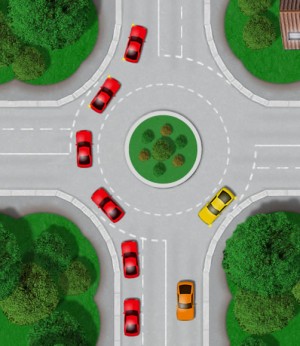
Straight ahead at a roundabout is usually the second exit.
When approaching a roundabout, it’s tempting to stare only to the right (where traffic is coming from). This is risky because you can drift from your lane and miss what’s happening ahead.
On approach, keep your eyes moving:
- look ahead to keep your position,
- glance right to see if you need to give way, and
- repeat this briskly.
MSPSL for Straight Ahead
- Mirror: Check the interior mirror as you approach.
- Signal: No signal on approach when going straight ahead (unless signs/markings say otherwise).
- Position: Usually the left lane for straight ahead, unless road signs or markings show a different layout.
- Speed: Judge if the roundabout is open or closed – slow right down if you’re unsure, and be prepared to stop at the line.
- Look: Give way to traffic from the right. Just after you pass the first exit, check the interior mirror, then the left mirror and signal left to exit.
Once you have left the roundabout, cancel the signal if it has not cancelled automatically.
We’ll walk through local roundabouts step-by-step until you feel confident.
Contact us to check lesson availability →
Turning Right at a Roundabout

Turning right at a roundabout is usually the third exit.
Approaching to turn right will usually mean using the right-hand lane. Sometimes different lane use is shown by road signs or markings – always follow those first.
MSPSL for Turning Right
- Mirror: Check the interior mirror, then the right mirror.
- Signal: Signal right.
- Position: Move into the right lane on approach (unless signs/markings say otherwise).
- Speed: Decide if the roundabout is open or closed and slow to a safe speed. If in doubt, be prepared to stop just before the line.
- Look: Give way to traffic from the right, then join when safe.
Stay in the right lane while you go around. After passing the second exit:
- check the interior mirror, then the left mirror,
- check the left blind spot,
- signal left and carefully move over into the left lane to exit.
Upon leaving the roundabout, ensure your indicator has cancelled.
Although many everyday drivers don’t follow this properly, examiners will expect the full mirror–signal–position routine on your test.
Exiting Roundabouts
One common test fault is forgetting to cancel the indicator after leaving a roundabout. This can mislead other drivers and pedestrians about where you are going.
Pedestrian crossings are often positioned just beyond roundabout exits. This can cause queuing back onto the roundabout itself.
Tips:
- Try to glance towards your exit as you approach to see if traffic is queuing.
- Keep good lane discipline as you join any queue.
- Once off the roundabout, always check and cancel your signal if needed.
Driving Test – Roundabout Tips
- Locate roundabouts early so you have time to prepare.
- Always read road signs and lane markings to pick the correct lane.
- Decide if the roundabout is open or closed as you approach.
- Approach slowly – if it’s closed or you’re unsure, be ready to stop.
- Never stop over the junction line.
- If you realise you’re in the wrong lane, only change if it is clearly safe using mirrors, blind spot and a signal. If not safe, stay in the lane and take a different exit – this will not fail your test if it’s done safely.
- On approach, keep checking right and ahead so you don’t drift out of your lane.
- If the roundabout is busy with standing traffic, join but avoid blocking any entrances or exits.
- Always follow MSPSL and remember to cancel your signal after exiting.
What Lane to Use at Roundabouts
As a general guide (unless signs or road markings say otherwise):
- Turning left – first exit: left (outside) lane.
- Following the road ahead – second exit: left (outside) lane.
- Turning right – third (or last) exit: right (inside) lane.
Wrong Lane at Roundabouts
A very common test fail is:
- realising you are in the wrong lane,
- panicking, and
- swerving into the “correct” lane without checking properly.
Being in the wrong lane alone is not a fail. It’s the unsafe correction that fails tests.
If you realise you are in the wrong lane you have two options:
- Change lanes safely: use mirrors, check the blind spot, signal and only move if you have enough space and time so other drivers don’t have to brake sharply or swerve.
- Stay in your lane: if it isn’t safe to move, stay where you are and take the exit from that lane. The examiner will guide you back onto the correct route afterwards.
The test is about safe, calm decisions, not following directions perfectly.
Roundabout Signs
Always look out for signs, as they give you time to prepare for the roundabout layout ahead. Larger roundabouts usually have clear advance signage; some small ones may not.
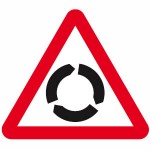
UK roundabout sign
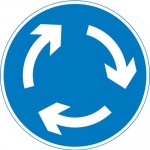
UK mini roundabout sign
Driving Lessons – Roundabouts
Whether you are:
- an experienced driver from another country, or
- a learner practising with parents or friends,
it is a good idea to take lessons with a local, qualified instructor.
An experienced instructor will:
- know the local test routes,
- know which roundabouts cause the most test fails, and
- help you practise them from every approach until you’re confident.
AMDI Driving School covers Hackney and nearby boroughs with calm, structured lessons.
Manual lesson prices →
Automatic lesson prices →
Or contact us here →