
Learning How to Deal With Mini Roundabouts
Mini roundabouts are almost certain to be part of your driving test if they appear on your local driving test centre routes.
They are often used instead of T-junctions in quieter residential areas. A mini roundabout has two main jobs:
- to act as a junction between two or more roads, and
- to slow traffic down as a form of traffic calming.
Because they are small and often busy, mini roundabouts can be confusing – especially when it comes to who has priority. At AMDI Driving School, we know many students are unsure how to deal with mini roundabouts, so this guide explains the correct procedure and rules in simple steps.
Practise them calmly with a DVSA-approved instructor who knows the local test routes.
View manual lesson prices →
View automatic lesson prices →
Or call us on 07866 941 436
Learning Mini Roundabouts
Although the basic rules are similar to larger roundabouts, mini roundabouts:
- are smaller,
- are often on narrower residential roads, and
- require very good observation.
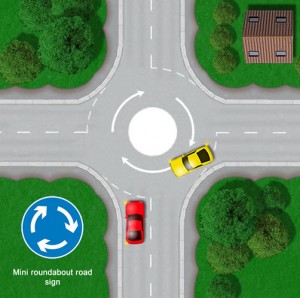
Mini roundabout with road markings and sign
Mini roundabouts can be hard to spot because of their size. A blue mini roundabout sign is not always present, so on your driving test you must keep a close eye on:
- road markings,
- give-way lines, and
- any traffic crossing in front of you.
The usual road marking is a painted white circle or a small white circular hump in the centre with three clockwise arrows around it.
Open and Closed Mini Roundabouts
Because mini roundabouts are commonly used in built-up areas, they are often placed at closed junctions – where you can see very little of the traffic coming from other roads.
On your test, examiners use these to see whether you:
- can tell if a junction is open or closed, and
- adjust your speed and observations correctly.
A closed mini roundabout must be approached very slowly. If you are unsure, stop at the line and:
- edge forward with clutch control, and
- keep checking all entrances and exits before you move.
Right of Way at a Mini Roundabout
As with all roundabouts in the UK, drivers approaching a mini roundabout must give way to traffic coming from the right that is already on, or just about to enter, the roundabout.
Mini Roundabouts and Indicating
The indicator rules are similar to normal roundabouts:
- Signal left if turning left.
- Signal right if turning right.
- No signal on approach for straight ahead.
Because mini roundabouts are small, you normally do not need an exit signal – you are on and off so quickly that a second signal is not required.
However, on mini roundabouts most drivers do signal, especially when turning right. On such a tight circle, failing to signal right can be very dangerous, as other drivers may wrongly think you are going straight.
We’ll break them down slowly in quiet areas before tackling busier junctions.
Contact us to check lesson availability →
Mini Roundabout Rules (Driving Test)
During the driving test, the examiner will expect the following procedures.
Turning Left at a Mini Roundabout
- Check the interior mirror, then the left mirror.
- Signal left.
- As this is usually a residential area, check the left mirror again for cyclists just before turning.
- Approach slowly, be ready to stop if a vehicle or cyclist is coming from the right.
Straight Ahead at a Mini Roundabout
Mini roundabouts are junctions and are treated as hazards.
- Check the interior mirror on approach.
- No signal is needed for straight ahead.
- Approach at a low speed, looking ahead and to the right.
- Give way to traffic from the right and only go when it is clearly safe.
Turning Right at a Mini Roundabout
- Check the interior mirror, then the right mirror.
- Signal right early so others know your intention.
- You do not need to signal left to exit as you would on a larger roundabout.
- Approach slowly, give way to the right and keep tight to your side of the road as you turn.
Mini Roundabout Road Markings
The white centre circle of a mini roundabout can be:
- just painted onto the road, or
- a small raised hump.
During the driving test you should avoid driving over the central circle if you can.
- Lightly clipping it with a wheel is unlikely to fail you.
- Deliberately driving straight over the circle is likely to be marked as a fault and could fail the test.
You should also try to avoid driving over any hatched (diagonal) markings near the roundabout. These markings are there to separate traffic and increase safety:
- Hatchings with a solid white border must not be crossed.
- Hatchings with a broken white line may be crossed, but it is better to avoid them unless necessary.
Mini Roundabout U-Turns
Avoid making U-turns on mini roundabouts. They are too small for this to be done safely in most cases.
If you need to turn around:
- use a quiet side road for a turn in the road, or
- reverse around a corner where it is safe and legal.
Be extra cautious that other drivers may attempt unsafe U-turns on mini roundabouts – especially those in a hurry or unfamiliar with the area.
Mini Roundabout Accidents
Because mini roundabouts are small and busy, two common causes of accidents are:
- Not indicating when turning right – drivers coming the other way may think you are going straight.
- Stopping when there is no need – drivers behind may not expect you to brake.
Stopping at Mini Roundabouts
Unnecessary stopping at mini roundabouts is an easy way to pick up serious faults on a driving test.
You should stop if:
- the roundabout is closed and you cannot see clearly, or
- you must give way to a vehicle or cyclist from the right.
You shouldn’t stop just because:
- a car is coming from the left, or
- a vehicle is still far away and clearly has time to slow or stop.
If you stop suddenly when it is actually your priority to go, the vehicle behind you may not be expecting it, which increases the risk of a rear-end collision.
Mini Roundabouts and Cyclists
It is legal to overtake a cyclist at a mini roundabout, but on a driving test it is often safer to:
- slow down and stay behind them, and
- wait until they have fully cleared the mini roundabout.
This is because:
- cyclists can change direction suddenly, and
- there may not be enough room to overtake without going over the central circle.
Tutorials and Guides Related to Mini Roundabouts
If you’re based in East London and would like to learn to drive, you can see our affordable lesson prices and packages for both manual driving lessons and automatic driving lessons.
Practise them step-by-step with a patient instructor in Hackney and surrounding areas.
View manual lesson prices →
View automatic lesson prices →
Contact us to book your lessons →
DVSA-Approved Instructor • Manual & Automatic • ★★★★★ Local Reviews
Start here: AMDI Driving School